
How to Use the Talk Debt Assessment Tool: A Step-by-Step Walkthrough
Understanding your financial position starts with knowing what you earn, what you spend, what you owe and what you own. However, bringing all this information together can be challenging, particularly when you have multiple debts, different income sources and outstanding financial commitments.
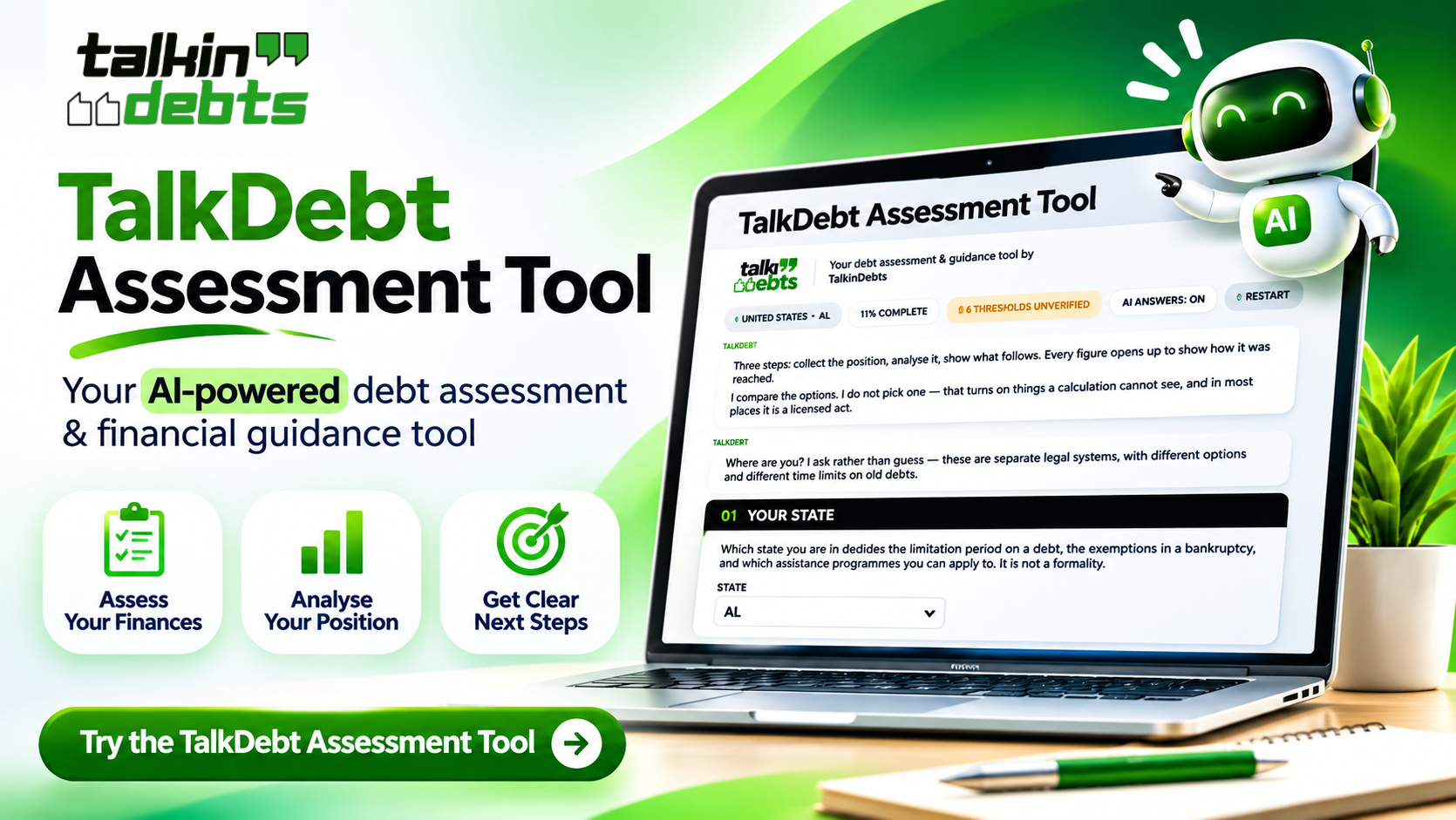
The TalkDebt Assessment Tool by TalkinDebts makes this process easier through an AI-assisted, conversational assessment that helps you review your financial circumstances and understand the numbers behind them.
Unlike a basic debt calculator, TalkDebt looks at several aspects of your financial position, including income, essential expenses, priority debts, other outstanding debts and assets. It then calculates relevant financial indicators, explains the results and highlights information that may require further attention.
The assessment follows three simple stages: collect the position, analyse it and show what follows.
In this guide, we explain how the TalkDebt Assessment Tool works, what information you need, how to complete the assessment and what to expect from your results.
Ready to start? Try the TalkDebt Assessment Tool.
What Is the TalkDebt Assessment Tool?
The TalkDebt Assessment Tool is an AI-assisted online debt assessment and guidance tool developed by TalkinDebts.
It combines a structured financial assessment with a conversational AI interface, allowing users to enter financial information, answer guided questions and review their circumstances.
The tool examines several important areas:
- Income and regular earnings.
- Essential household expenses.
- Priority debts and arrears.
- Other outstanding debts.
- Assets and property.
- Personal financial priorities.
Once the information is collected, TalkDebt calculates relevant financial figures and presents an assessment report.
AI-generated explanations help users understand the results, while individual calculations can be opened to show how figures were reached.
The tool does not automatically select a debt solution or replace professional financial or legal advice. Its purpose is to make financial information easier to understand and identify what may need attention.
How Does the AI-Powered TalkDebt Assessment Work?
TalkDebt combines AI-assisted interaction with structured financial calculations.
Conversational AI: Users can interact with the tool through a chat-style interface, answering questions and describing certain information in their own words.
Financial analysis: The assessment processes the information entered to calculate income, expenses, available monthly capacity, outstanding debts and other financial indicators.
AI-generated explanations: AI helps translate assessment results into understandable explanations, highlighting important figures and areas requiring attention.
Transparent calculations: Users can open individual figures to examine how they were calculated. The numerical results come from the underlying calculations, not independently generated AI estimates.
Jurisdiction-specific assessment: Users select their country and state where applicable. This provides context for relevant legal thresholds and financial considerations. Some thresholds may remain unverified and are identified within the tool.
How to Use the TalkDebt Assessment Tool
The assessment takes you through a series of steps to build a clearer picture of your financial position.
Step 1: Select Your Location
Visit the TalkDebt Assessment Tool and begin the assessment.
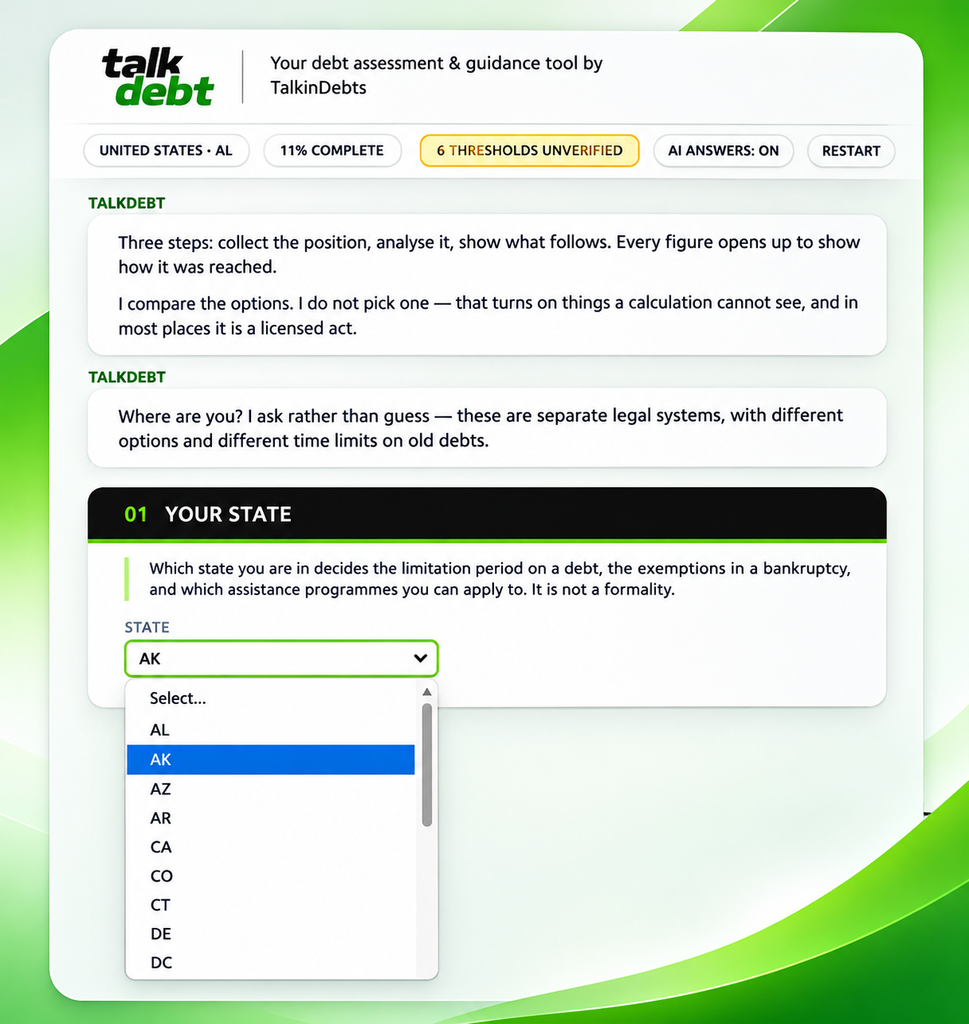
The first stage asks you to select your relevant jurisdiction.
For example, users selecting the United States are asked to choose their state. This matters because certain debt-related rules, limitation periods and bankruptcy exemptions differ between states.
Step 2: Enter Your Income
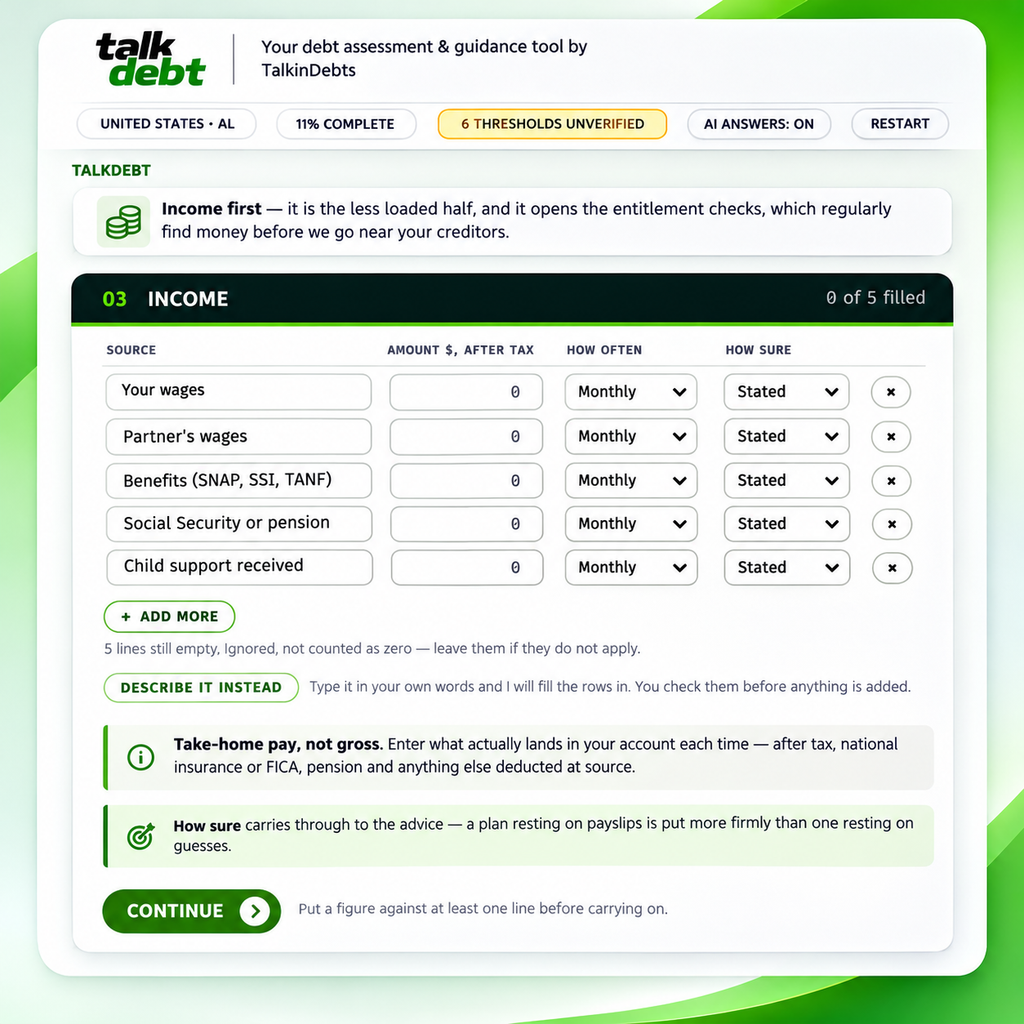
The next section collects your income details.
You can record different sources, including:
• Your wages.
• Partner’s wages.
• Benefits, including SNAP and SSI.
• Social Security or pension.
• Child support received.
Enter the amount, payment frequency and how certain you are about each figure.
You can also add additional income sources or use the Describe It Instead option to explain your income in your own words.
One important instruction is to enter take-home pay rather than gross salary. This means using the amount that actually reaches your account after applicable deductions.
Step 3: Record Your Essential Expenses
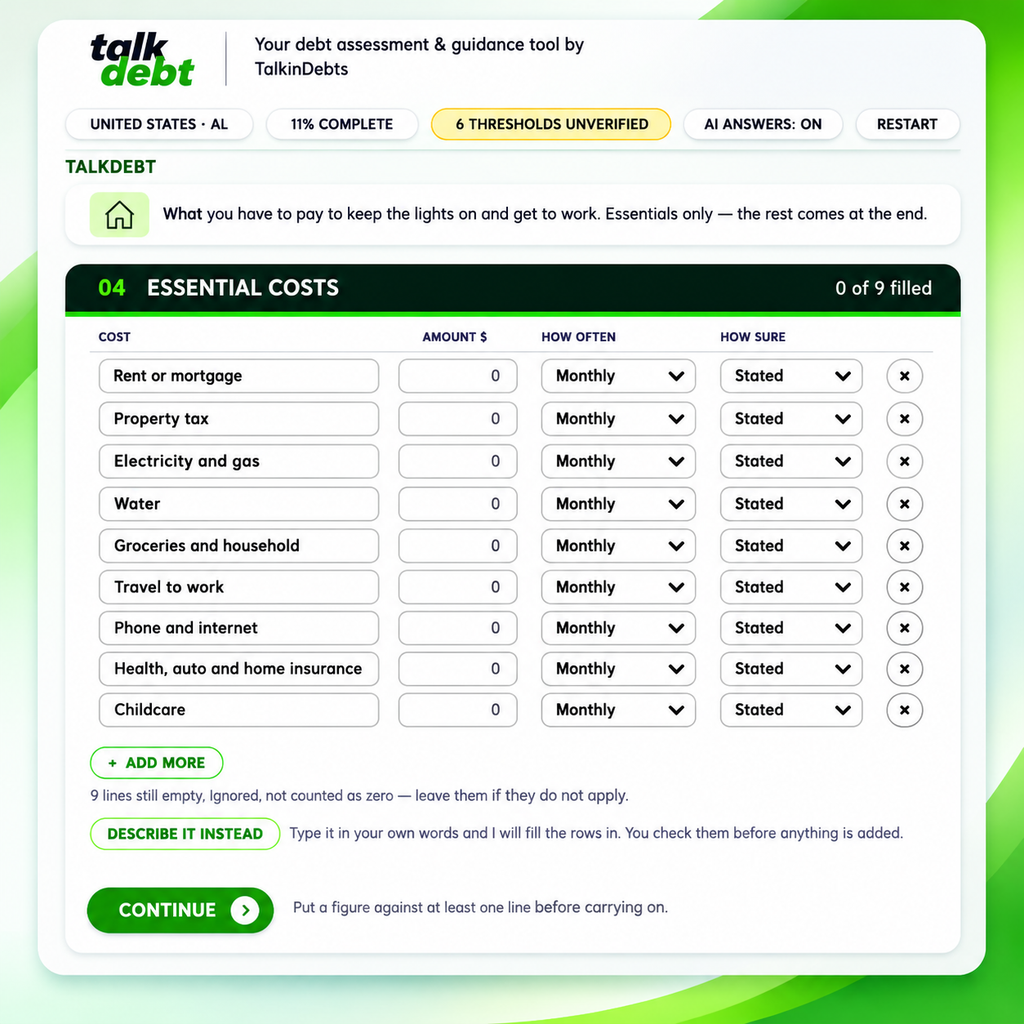
Next, enter your regular household and living expenses.
The assessment includes categories such as rent or mortgage, property tax, electricity, gas, water, groceries, transportation, phone, internet, insurance and childcare.
Enter the relevant amounts and payment frequencies.
Accurate expense information helps the tool calculate how much income remains after essential costs.
If an expense does not apply, you can leave the field empty rather than entering an assumed zero.
Step 4: Add Priority Debts and Other Outstanding Debts
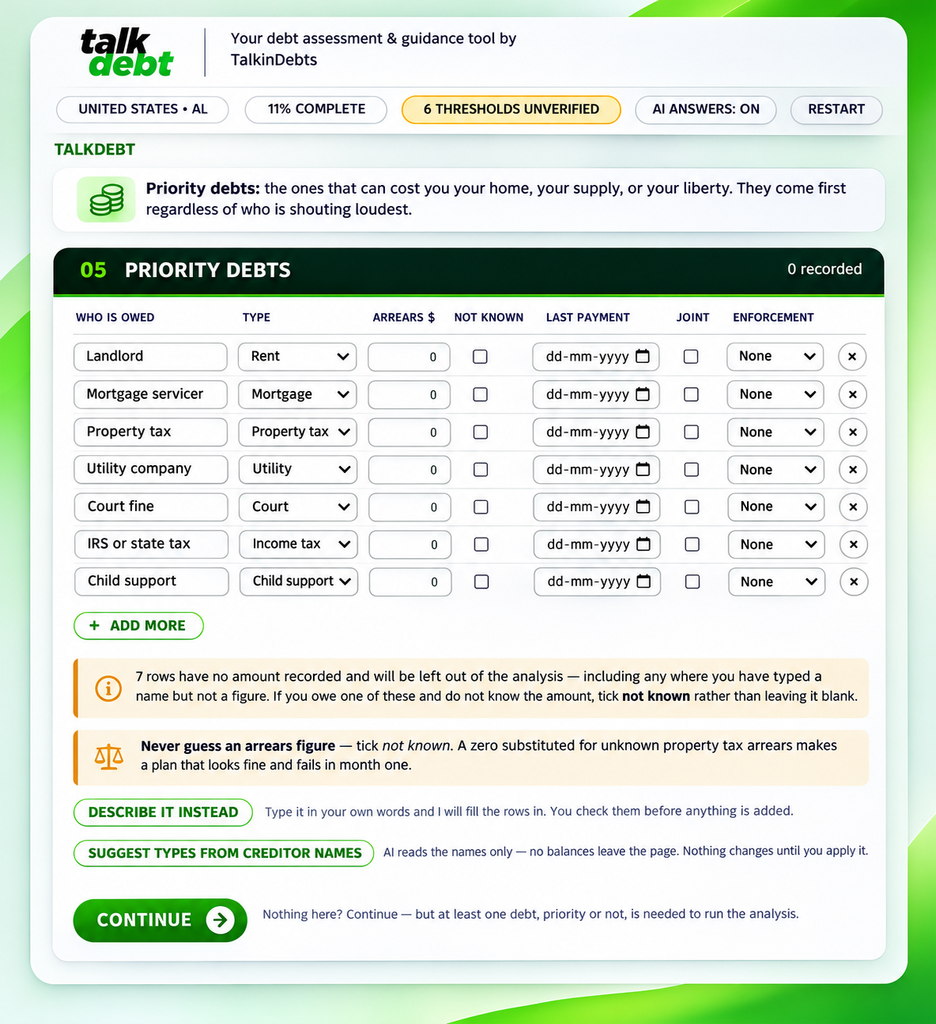
TalkDebt separates priority debts from other outstanding financial obligations.
Priority debts include rent arrears, mortgage arrears, property tax, utility debts, court fines, tax obligations and child support.
The assessment allows you to record amounts outstanding, last payment dates, joint liability and enforcement information.
Other debts cover obligations such as credit cards, personal loans, overdrafts and other creditor accounts.
You can enter creditor details, debt type, outstanding balance, interest rate, last payment date and other relevant information.
An important feature is the ability to mark an amount as unknown rather than guessing.
The last-payment date is also particularly important because it may affect the assessment of applicable limitation periods. If you do not know the date, check bank statements and account records where possible.
Step 5: Add Your Assets
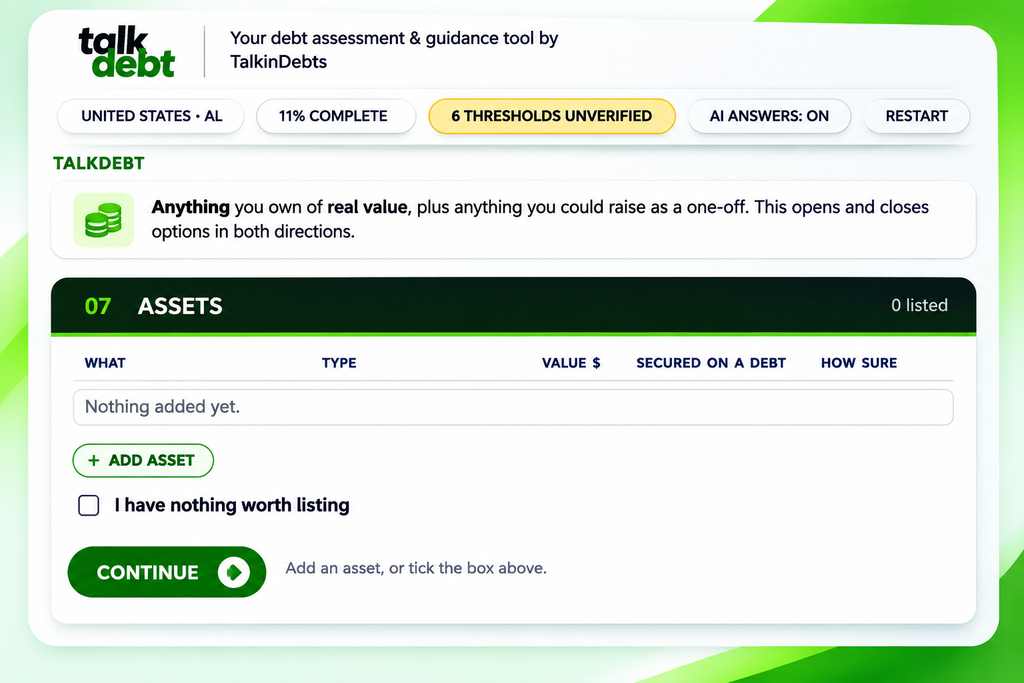
The assessment also considers what you own, not just what you owe.
You can add assets by recording their description, type, estimated value, whether they are secured against a debt and how certain the valuation is.
If you have no assets to list, the tool provides an option to indicate this.
This information contributes to a broader understanding of your financial position.
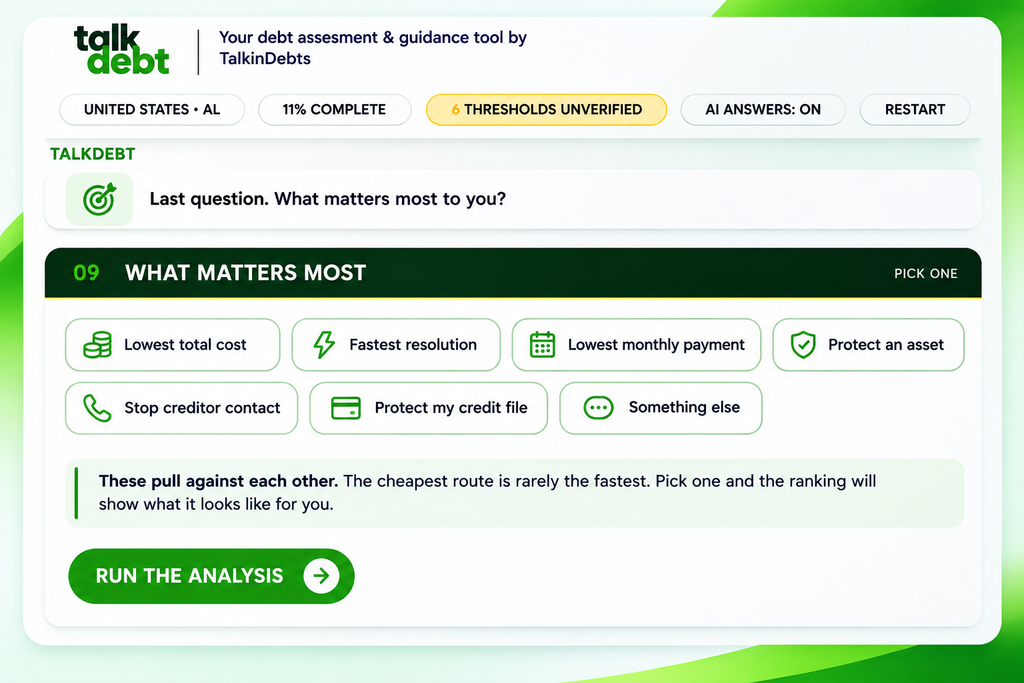
Step 6: Select What Matters Most
Before running the analysis, TalkDebt asks what matters most to you.
Available priorities include:
• Lowest total cost.
• Fastest resolution.
• Lowest monthly payment.
• Protect an asset.
• Stop creditor contact.
• Protect your credit file.
• Something else.
These priorities can involve trade-offs. For example, the lowest-cost approach may not necessarily be the fastest.
Selecting your priority provides additional context for understanding your objectives.
Step 7: Run the Analysis
Once the required information has been entered, select Run the Analysis.
TalkDebt processes the information and generates an assessment of your financial position.
The results bring together your income, essential expenses, debts, assets and relevant financial calculations.
What Does the TalkDebt Assessment Report Include?
The final assessment report brings together the key information collected during the process.
Here are some of its main features.
Financial Position Summary
The report presents important figures, including:
• Net monthly income.
• Essential monthly costs.
• Available monthly surplus.
• Outstanding non-priority debts.
• Number of creditors.
• Estimated debt repayment time under stated calculation assumptions.
This provides an overview of your financial circumstances.
Income and Expense Breakdown
The report shows how your income is allocated across essential costs, other expenditure, emergency buffer, arrears catch-up and available funds for creditors.
This makes it easier to understand how the different figures contribute to your remaining monthly capacity.
Assets Compared With Outstanding Debts
The owned-versus-owed section provides a comparison between recorded assets and outstanding obligations.
It helps present a broader financial picture rather than focusing only on debt balances.
Missing Information and Priority Actions
TalkDebt can highlight missing information that requires attention.
For example, a missing last-payment date may prevent the assessment from establishing the applicable limitation status.
The report can explain why this information matters and identify practical actions, such as checking bank statements and credit records.
Detailed Report by Email
Users can also request the full report by email.
The expanded report can include additional cost analysis, relevant schemes to investigate, balance sheet information, financial health ratios and the calculations behind the displayed figures.
AI-Generated Guidance and Free Support Resources
One of the useful aspects of TalkDebt is that it does more than display financial figures.
AI-generated explanations help users understand the results and identify information that may need further attention.
The assessment can also highlight relevant free support resources.
For US users, the sample report includes:
• NFCC – Non-profit credit counselling through member agencies.
• HUD-approved housing counsellors – Housing-related counselling.
• Consumer Financial Protection Bureau – Consumer information and complaint resources.
• Legal Services Corporation – Information about free legal assistance for eligible individuals.
These are independent resources, and eligibility depends on individual circumstances.
Start Your TalkDebt Assessment Today
Understanding your financial position starts with having the right information.
The TalkDebt Assessment Tool brings together income, expenses, outstanding debts and assets through a structured assessment supported by AI-powered interaction.
From collecting your financial details to calculating available monthly capacity and explaining important findings, it provides a clearer view of the information you enter.
Know your debt number. Understand your position. See what follows.
Start Your TalkDebt Assessment →
TalkDebt – Your debt assessment and guidance tool by TalkinDebts.
Frequently Asked Questions About Tracking Your Debt
Tracking your debt helps you understand your total outstanding balances, monitor repayment progress, compare interest costs, and organise payment deadlines. It also gives you a clearer starting point for developing a realistic repayment plan.
A monthly review is a practical starting point for most people. You may need to check more frequently if your balances change significantly, you have irregular income, or several payments are approaching.
You can use a spreadsheet, a budgeting application, or a written list. Record each balance, interest rate, minimum payment, and due date, then update the information regularly.
Tracking alone does not eliminate debt. However, it can help you identify priorities, understand interest costs, manage payments, and make more informed decisions that support your repayment goals.
A debt clock generally displays a debt figure that changes over time, often to illustrate broader borrowing trends. A personal debt tracker records an individual’s actual balances, payments, and repayment progress. Check what a specific tool measures before relying on it for personal financial planning.
Take the First Step Toward Taking Control of Your Debt
You cannot make informed decisions about debt without understanding what you owe. Tracking your balances, interest rates, payment deadlines, and repayment progress helps turn financial uncertainty into a clearer plan of action.
Start by reviewing your accounts, calculating your total outstanding debt, and setting realistic repayment priorities. Review your progress consistently and adjust your approach when your circumstances change.
Ready to build greater awareness of debt? Visit the TalkinDebts Your Debt Clock to explore the debt clock and take a moment to reflect on your own financial position.
Understanding debt is the beginning. Consistent tracking, informed decisions, and realistic financial habits can help you work toward a more manageable financial future.